
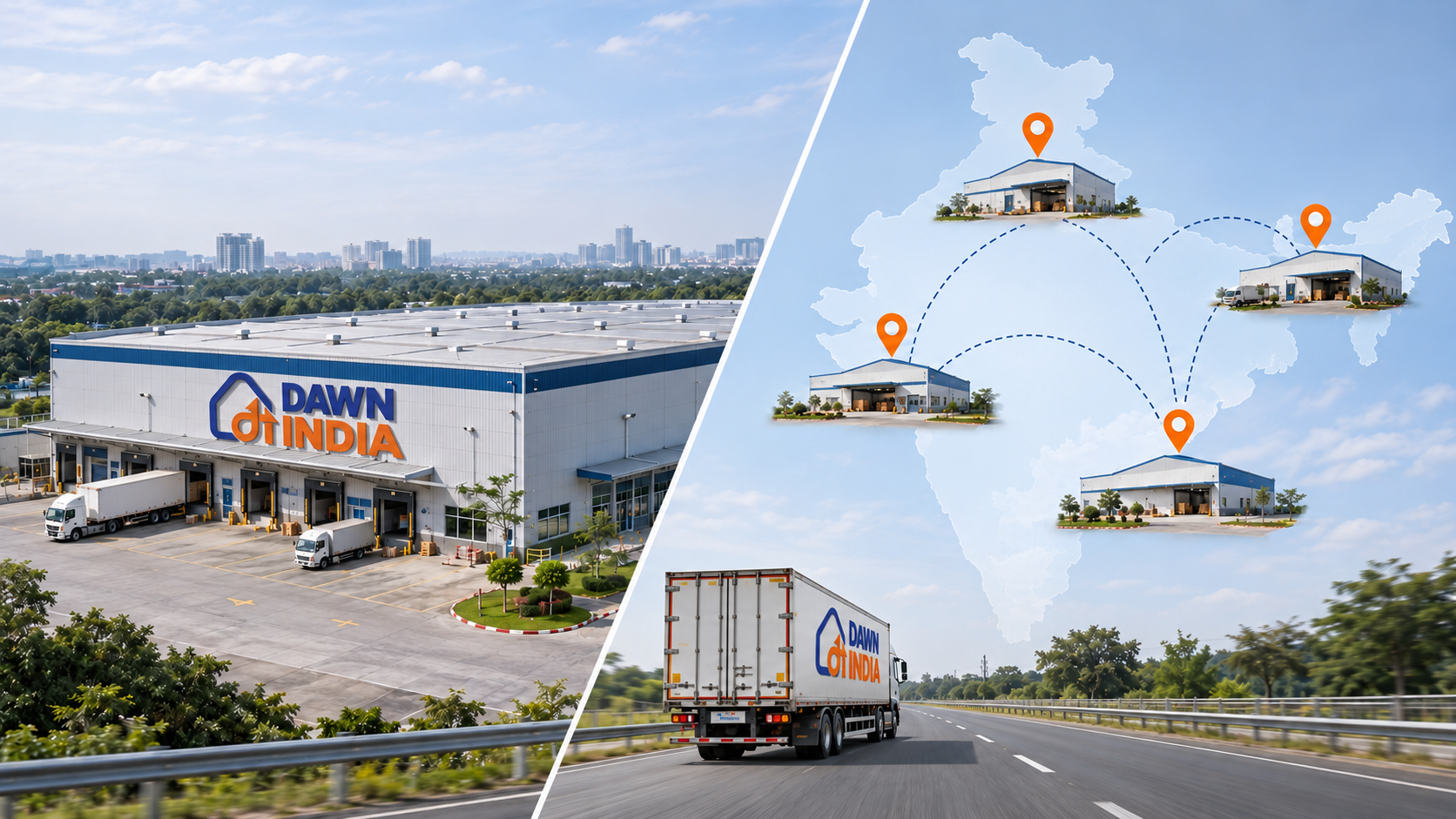

As businesses expand into new cities and markets, warehousing becomes an important part of distribution planning. Where products are stored can directly affect delivery speed, transportation costs, inventory availability and customer service.
Some businesses prefer to keep inventory in one central warehouse, while others use multiple regional warehouses closer to their customers. Both models have their advantages, and the right choice depends on factors such as market coverage, product demand, delivery requirements and supply chain structure. Understanding the difference between centralised and regional warehousing can help businesses choose a model that supports their distribution needs without adding unnecessary complexity.
What Is Centralised Warehousing?
In a centralised warehousing model, inventory is stored mainly in one large facility or a limited number of strategically located warehouses. Products are received, stored and distributed from these locations to different markets.
This model gives businesses greater control over inventory because stock is managed through fewer locations. It can also make warehouse operations easier to standardise, with common processes for receiving, storage, picking, packing and dispatch. Centralised warehousing can be suitable for businesses where customers are concentrated in a particular region or where products do not require extremely fast delivery.
However, when customers are spread across different parts of the country, goods may need to travel longer distances from the central warehouse. This can increase transportation time and make last-mile distribution more challenging.
What Is Regional Warehousing?
Regional warehousing involves maintaining inventory in multiple locations closer to different customer or market areas. For example, a business serving customers across several regions may position inventory closer to major demand centres. Orders can then be fulfilled from the warehouse that is best placed to serve the customer.
The main advantage is shorter delivery distances and faster replenishment. Regional warehouses can also help businesses respond more quickly to changes in local demand. However, managing multiple warehouses requires better inventory coordination. Businesses need visibility into stock levels across locations to avoid having excess inventory in one warehouse while another location faces a shortage.
Centralised vs Regional Warehousing
The right model depends on what the business is trying to achieve.
| Centralised Warehousing | Regional Warehousing |
|---|---|
| Inventory is concentrated in fewer locations | Inventory is distributed across multiple locations |
| Easier central inventory control | Faster access to local markets |
| Can simplify warehouse management | Can reduce delivery distances |
| May increase transportation distance | Requires stronger inventory coordination |
| Suitable for concentrated demand | Useful for geographically distributed demand |
Neither model is automatically better. The decision should be based on customer locations, order volumes, delivery expectations, product characteristics and overall logistics costs.
When Does Centralised Warehousing Make Sense?
Centralised warehousing can work well when a business has relatively concentrated demand or when customers are willing to accept longer delivery timelines. It can also be useful when inventory needs to be tightly controlled or when products are expensive and businesses want to avoid distributing stock across many locations.
For businesses that are still developing their distribution network, starting with a centralised warehouse can provide a simpler operating structure. As demand grows, the business can then evaluate whether additional regional facilities are required.
When Is Regional Warehousing a Better Choice?
Regional warehousing becomes more attractive when customers are spread across different markets and delivery speed is important. Keeping products closer to demand areas can help businesses reduce the distance goods need to travel after an order is received. This can support faster deliveries, better replenishment and improved customer service.
Regional warehousing can also be useful for FMCG, retail, e-commerce and other businesses where product availability and delivery speed are important. Dawn India itself highlights regional warehousing and distribution as part of logistics planning for businesses expanding across markets.
However, businesses should avoid creating too many warehouses without proper demand planning. More locations mean more inventory decisions, additional coordination and greater operational complexity.
Can Businesses Use a Combination of Both?
Yes. Many businesses can benefit from a hybrid warehousing model that combines centralised and regional distribution. For example, a central facility can hold larger quantities of inventory, while regional warehouses can maintain faster-moving products closer to key markets.
This approach can provide a balance between inventory control and delivery responsiveness. The central warehouse can support replenishment, while regional facilities handle local order fulfilment.
The right structure depends on the company's market coverage, product movement and customer delivery requirements.
What Should Businesses Consider Before Choosing a Model?
Before deciding between centralised and regional warehousing, businesses should evaluate several factors.
- Customer locations: Where are most customers and distribution points located?
- Demand patterns: Are orders concentrated in a few markets or spread across different regions?
- Delivery expectations: How quickly do customers need their orders?
- Product characteristics: Do the products have specific storage, handling or temperature requirements?
- Inventory levels: Can inventory be efficiently divided between multiple locations without creating excess stock?
- Transportation costs: How will warehouse locations affect inbound and outbound transportation?
- Scalability: Can the chosen model support future business expansion?
A warehouse strategy should be based on the complete supply chain rather than storage space alone.
How Technology Supports Multiple Warehouses
As the number of warehouse locations increases, inventory visibility becomes increasingly important. Warehouse Management Systems, barcode scanning, inventory tracking and real-time reporting can help businesses understand where stock is stored, how much is available and which locations require replenishment.
This allows businesses to coordinate inventory between warehouses and reduce the risk of stockouts or unnecessary excess inventory. For businesses operating multiple locations, connecting warehousing with transportation and order management can provide better visibility across the complete distribution process.
How Dawn India Can Support Your Warehousing Needs
Choosing the right warehousing model is only one part of building an efficient distribution network. Businesses also need reliable storage, inventory handling, order fulfilment, dispatch and distribution coordination.
Dawn India provides warehousing and logistics solutions designed around different business requirements, including 3PL and inventory management, customs bonded warehousing, cold-chain warehousing and distribution support. Its warehousing operations include receiving, inventory coordination, order preparation, picking, packing and dispatch support.
For businesses expanding across markets, Dawn India can support the wider logistics process through warehousing, contract logistics, freight forwarding and distribution coordination. This allows businesses to consider their storage and distribution requirements together rather than treating warehousing as an isolated activity.
Conclusion
There is no single warehousing model that works for every business. Centralised warehousing can provide stronger inventory control and simpler operations, while regional warehousing can bring products closer to customers and support faster distribution. The right choice depends on customer locations, demand patterns, delivery expectations, product requirements and the overall supply chain strategy.
For businesses expanding into new markets, a well-planned combination of centralised and regional warehousing can provide the right balance between inventory control, distribution speed and operational efficiency. With the right warehousing and logistics partner, businesses can build a distribution network that is flexible enough to support current requirements while preparing for future growth.